REL 231 - History of the Christian Church
Course Notes
Week 9
The religious views of Kings and Queens were important for the development of religion within their kingdoms.
For example, if you were writing an essay on Elizabeth I of England some of the questions you should consider would be : How did her views and upbringing show itself in her treatment of Protestants, Roman Catholics, Puritans ? In what direction did she steer the Church of England? Why?
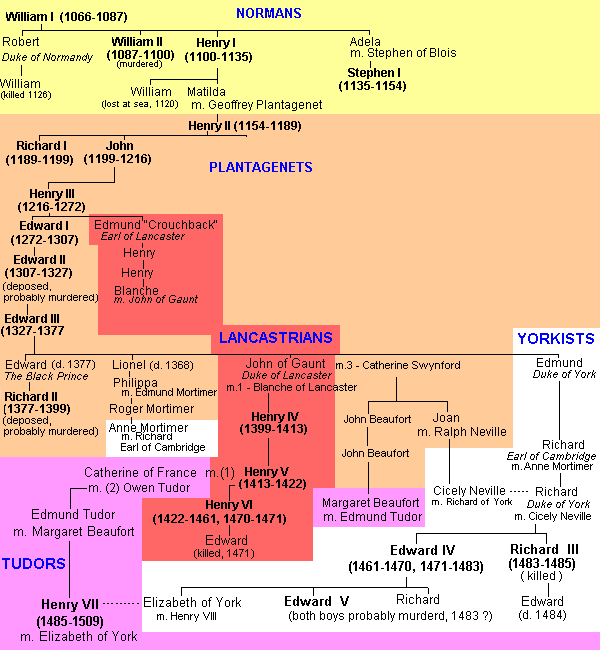
For the Reformation in England it is important to know that the period preceding this was a time of war which lasted for about 100 years - wars between England and France, followed by about thirty years of the "Wars of the Roses" (between the Houses of York and Lancaster), which had arisen because of disputes as to who was the legal heir to the throne.
Henry VII was the Lancastrian/Tudor heir who won one of the last battles, and then married a Yorkist princess to consolidate his claim to the throne.
Henry VIII was the second son of Henry VII (his older brother Arthur died before becoming king), and Henry VIII desperately wanted a legitimate male heir to the throne. He knew that otherwise the kingdom might well suffer civil war again. That was the background to why Henry VIII wanted to divorce his aging wife Katherine of Aragon. The Pope could not grant a divorce, because the Pope was a virtual prisoner of Katherine's uncle.
So Henry VIII eventually cut loose from papal authority - and to do that he had to cut loose from the Roman Church. That led to Henry VIII encouraging the reformers to some extent.
Henry's young son Edward was brought up in the Reformation tradition, and took the Church further to the Protestant side. Edward died as a teenager.
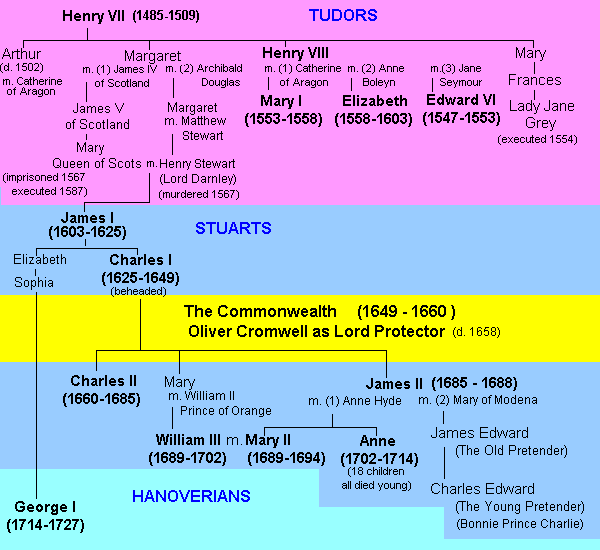
There was an abortive attempt to make a protestant girl relation queen (Lady Jane Grey), and then Edward's older sister Mary I became Queen.
Mary was the daughter of Henry VIII and Katherine of Aragon, and was a staunch Roman Catholic, so she forced England to go back to being Roman Catholic. Protestants were persecuted, some were burned to death as heretics, and Mary became known as "Bloody Mary". Although Mary married Philip of Spain she had no children, and her younger sister Elizabeth (daughter of Henry VIII and the protestant Anne Boleyn) became Queen.
Elizabeth I re-organized the Church as the Church of England, so the Pope excommunicated her. After that the protestant reformation was able to progress, and on Elizabeth's death her cousin James VI of Scotland became the constitutional monarch of both Scotland and England. Although James' mother was Roman Catholic (Mary Queen of Scots), James had been taken from her when he was a baby, and had been brought up as a Presbyterian under the influence of John Knox, so England and Scotland continued to have a State Church which was independent of Rome, and which was run on Protestant lines.
James I's son Charles I claimed the "Divine Right of Kings" to rule and to enforce his religious views on the country. This antagonized the extreme Protestant, Calvinistic and Puritan parties, and led to civil war. Charles I was defeated, and executed by his enemies.
The leader of the Puritans was Oliver Cromwell, who took the title of "Lord Protector of the Commonwealth". Under Cromwell's leadership the state Church in England and Scotland was initially Presbyterian and then the Army enforced an Independent polity. After Cromwell's death in 1658 there was a period of uncertainty; Cromwell's son did not want to lead the country, so eventually Charles I's eldest son was invited to come back (he had been living in Belgium) as a constitutional monarch.
On the Restoration of the monarchy in 1660, the Church of England was re-constituted and a new edition of the English Book of Common Prayer was brought into use by Parliament. There were tensions throughout Charles II's reign, because he favored the Roman Catholic Church (his wife was a Roman Catholic). Charles II had no legitimate children, and when he died his brother James became King James II.
James II continued to favor the Roman Catholics, and became one himself, so the country came to the brink of another civil war.
As a young man James had fallen in love with and married Anne Hyde, daughter of the Earl of Clarendon; they had had two daughters, Mary and Anne, who were both brought up as Protestants. Mary married her cousin William, Prince of Orange (Holland), and Anne married Prince George of Denmark. James' second wife, Mary of Modena, was a Roman Catholic, and for some years there were no children of the marriage. Most of the country was hoping that one of the girls would inherit the throne.
What brought matters to a head was the birth of a baby boy by James' elderly wife. There were immediate rumors that the baby was not the Queen's. It was claimed that he had been smuggled into her bedchamber in a warming-pan - hence the child was known as the Warming-Pan Baby.
Parliament invited William and Mary to come to Britain and take over from James II. James tried to rally support for himself, but eventually fled to Holland, taking his family with him, and throwing the Great Seal of Enlgand into the sea. The baby boy, James Edward, grew up to be known as "The Old Pretender" (to the throne), and his son was "The Young Pretender" both tried several times to invade England and get the throne. Many of the Scots supported the two Pretenders, because they were Stewarts; the Scottish uprisings were put down brutally by the English.
As a point of interest, portraits of the two Pretenders show them with facial features very similar to Charles II and James II. Queen Anne came to believe that James Edward was in fact her half-brother, but by that time Parliament had passed a law that a Roman Catholic could not become King or Queen of England.
Some writers say that Henry VIII of England "founded the Church of England". This is not really correct. Henry took advantage of the increasing movement towards Reformation which was already taking hold of England, and turned it to his advantage, first to legalize his divorce from Catherine of Aragon, and secondarily to grab money and lands from the Church.
The Time-Line below is given so that you may get an idea of who lived when, and also may appreciate the pressures acting on Henry VIII to make sure that he had a son who was legitimate and accepted as heir to the throne by the whole country.
Charts of the Kings of England, William I - Henry VII and Kings of England, Henry VII - George I are given to help you see the complexities of the line of succession, and the instability of the English monarchy at various periods
Time Line, events and characters for this period
- 1337 - 1453 : The Hundred Years' War
- Between England and France, caused by Edward III of England claiming the French crown, and giving himself the title "King of France", The war was fought mainly in France. There were some outstanding English victories at Crécy (1346), Poitiers (1356), Agincourt (1415). The war ended with England giving up all territory that had been gained in France, except for the port of Calais. Generations of young men were killed, and the countries were exhausted. The net gain was one town, which was lost to the French in 1558
- 1380 - 1471 : Thomas á Kempis
- German mystic who wrote the "Cloud of Unknowing" which is still a great spiritual classic
- 1396 - 1468 : Johann Gutenberg
- German, inventor of the European printing press. Printed a Bible in Germany in 1453
- 1412 - 1431 : Joan of Arc
- French peasant girl who led the French against the English, was betrayed, and burnt at the stake by the English
- 1422 - 1491 : William Caxton
- The first English printer, went to Europe to learn the techniques of printing, published the first printed book in English (1474), set up a printing press in London (1476), published Chaucer's Canterbury Tales (1484)
- 1434 - 1464 : Cosimo de' Medici
- Florentine Merchant Prince
- 1449 - 1492 : Lorenzo de' Medici
- "Il Magnifico", member of the de' Medici family of merchants in Florence, Italy. Great patron of the arts. Members of the de' Medici family were equivalent to princes, and married into several of the royal families of Europe.
- 1451 - 1506 : Christopher Columbus
- First voyage of Discovery towards America in 1492
- 1452 - 1498 : Girolamo Savonarola
- Italian Roman Catholic preacher, burned at the stake for heresy in Florence
- 1452 - 1519 : Leonardo da Vinci
- Italian genius, polymath, inventor, artist. Paints "The Last Supper" in 1495
- 1453 : Fall of Constantinople
- The end of the Byzantine Empire. The Turks captured Constantinople, killed the Emperor Constantine XI, and established an Islamic Empire in eastern Europe.
- 1455 - 1485 : The Wars of the Roses
- Henry VI of England became insane in 1453; his son Edward was born that same year. Richard, Duke of York, who also had a claim to the throne, became "Lord Protector", but was opposed by Henry VI's wife, Queen Margaret of Anjou, and civil war ensued.
In 1460 the King was captured by Richard of York, and forced to name Richard as heir to the throne in place of the King's baby son. A few months later Richard of York was killed in battle, but his son (also named Edward) continued the war.
In 1461 Richard's son claimed the throne and was crowned as Edward IV. Henry VI fled to Scotland with the Queen and his son, and stayed there until 1464.
In 1464 Henry VI returned to lead an uprising in the north of England, but was defeated and captured in 1465. He was imprisoned in the Tower of London for several years.
In 1470 there was a quarrel between Edward IV and one of his Earls, Richard Neville Earl of Warwick. Warwick set Henry VI free and made him King again - for a few months. Edward IV struck back, killed Henry VI's son Edward in battle, put Henry VI back in the Tower, and murdered him in 1471.
One of the reasons for the quarrel between Edward IV and Warwick was that in 1464 Edward had married Elizabeth Woodville, who was part of the Lancastrian family, and began to show favors to the Lancastrians rather than the Yorkists. There were seven children of the marriage - two sons, Edward and Richard, and five daughters, of whom the eldest, Elizabeth, was eventually forced into marriage with Henry VII.
In 1483 Edward IV died at the age of 40, naming his brother Richard as the Protector of his 12-year-old son Edward V and of England. The queen's family had aroused resentment amongst the other noble families. Richard seized the opportunity, put Edward V and his 9-year-old brother Richard in the Tower, and called a Council of Lords and Commons to declare that the Woodville marriage was invalid, the princes and princesses were bastards, and that Richard was the rightful heir to the throne.
Richard III was crowned in 1483, and probably murdered his nephews at that time. If Richard III did not have them killed, then his successor Henry VII did so in order to secure his claim to the throne
Almost as soon as Richard III was crowned, rebellion broke out, led by Margaret Beaufort and her son Henry Tudor. The rebellion was eventually successful, Richard III was killed in the Battle of Bosworth Field, and Henry Tudor was crowned as Henry VII in 1485. Henry VII strengthened his claim to the throne by forcing Elizabeth, the oldest surviving daughter of Edward IV, to marry him - 1465 - 1536 : Erasmus of Rotterdam
- Dutch scholar, traveled throughout Europe and England, studied the Greek text of the New Testament, made a new translation of the New Testament from the original Greek into Latin (ca. 1505). Although he paved the way for the Reformation, he himself remained a Roman Catholic
- 1468 - 1524 : Vasco da Gama
- Portuguese explorer,
- 1469 - 1527 : Nicolò Machiavelli
- Italian politician, author of "The Prince" - a book of instruction for rulers
- 1471 - 1528 : Albrecht Dürer
- German artist, particularly of religious themes, such as the "Praying Hands" - which were his brother's
- 1473 - 1543 : Nicholaus Copernicus
- European astronomer
- 1475 - 1564 : Michelangelo Buonarotti
- Italian artist, sculptor, architect
- 1478 - 1535 : Thomas More
- English scholar, friend of Henry VIII, but was executed by Henry because he would not renounce allegiance to the Roman Catholic Church
- 1479 : Spain
- Union of Ferdinand of Aragon and Isabella of Castile, leading to the formation of Spain as a political entity
- 1480 : The Inquisition
- Ferdinand and Isabella appointed Inquisitors to examine if conversion of Jews to Christianity in Spain was genuine
- 1480 - 1521 : Ferdinand Magellan
- Portuguese explorer
- 1483 - 1545 : Martin Luther
- German monk who broke with Rome, led the Reformation in Germany, translated the Bible into German, wrote hymns in German (said "Why should the devil have all the best tunes?")
- 1484 - 1531 : Ulrich Zwingli
- Swiss Reformer
- 1489 - 1556 : Thomas Cranmer
- English Reformer, became Archbishop of Canterbury during the reign of Henry VIII, translated and edited the first English "Book of Common Prayer", was burned at the stake by Mary I
- 1491 - 1556 : Ignatius Loyola
- Spanish mystic who founded the "Society of Jesus" (the Jesuits) in 1533, with the aim of renewing the Church by bringing education and preaching to the people. He wrote the "Spiritual Exercises" (ca. 1523) to help people come to a greater awareness of the presence of God
- 1491 - 1547 : Henry VIII
- Born in 1491 as the second son of Henry VII, and originally destined for the Priesthood, Henry became heir to the throne when his elder brother Arthur died in 1502. He became King in 1509, and in his early years was firmly against any attempts at reformation. In 1521 Henry wrote a treatise attacking Martin Luther and his teachings, for which Pope Leo X awarded Henry the title "Defender of the Faith" - a title which Henry and all successive English sovereigns have retained
In 1509 Henry married Catherine of Aragon, who had been married in 1501 to Henry's 16-year-old brother. A papal dispensation was necessary for the marriage because of the previous "marriage". Catherine swore later that the marriage with Arthur had never been consummated, and that she was a virgin when she went to Henry. Henry countered by saying that he was too young and inexperienced to know whether or not she had been a virgin when he married her.
Henry and Catherine were married for twenty years; Catherine had several miscarriages and children who died as infants. Only one child, a daughter, Mary, born in 1516, survived. Henry already had a healthy illegitimate son, Henry Duke of Richmond, so he blamed Catherine for not producing a healthy son as heir to the throne.
At some time between 1527 and 1530 Henry became enamored of Anne Boleyn, one of Catherine's Ladies in Waiting. Anne's elder sister Mary had already been seduced by Henry, and had been married off to a lesser noble and banished from court when she became pregnant, and Anne was determined not to fall into the same trap. Anne stuck out for marriage. Catherine was five years older than Henry, and showing her age. Henry convinced himself that the lack of a male heir from Catherine was the result of God's judgment on him for marrying his brother's widow, and asked the Pope for a ruling that the marriage was not valid and should be annulled. Pope Clement VII was willing to give a dispensation for a new marriage (basically allowing bigamy), but the Pope was virtually a prisoner of the Holy Roman Emperor Charles V (grandson of Ferdinand and Isabella, and nephew of Catherine). Charles V was not going to give permission for his aunt to be dishonored, so the Pope could do nothing more to placate Henry.
As a result of the stalemate with Rome, Henry's chief councilor, Thomas Wolsey, Cardinal, Papal Legate, Archbishop of York, Lord Chancellor of England, was disgraced and died in 1530 on his way to trial for high treason.
In 1529 Thomas Cranmer, a scholar who had been traveling around the European Universities and had come under the influence of the Reformers, suggested that Henry should appeal to the Universities for judgment on the validity of the marriage with Catherine. Henry liked the idea, and favorable judgments were obtained from some of the Universities where the Reformation had taken hold. So Henry determined on a "Reformation" for England - particularly by cutting free from Rome.
Henry prepared the way by engineering the consecration of Thomas Cranmer as Archbishop of Canterbury in 1533, and by forcing various Acts through Parliament - one of which was that appeals for divorce could not be heard by courts outside England. So in 1533 Henry had Archbishop Cranmer call Henry and Catherine to court to pass judgment on whether or not their marriage was valid. Catherine did not attend the court, so was judged in contempt of court. Cranmer ruled that the marriage was invalid, and that a secret marriage between Henry and Anne Boleyn earlier that year was in fact the valid marriage.
Catherine was banished from court, and kept as a virtual prisoner in various houses belonging to the King, until she died (probably of malnutrition and cold) in 1536. Her daughter Mary was not informed of her mother's death until two weeks after the event.
Pope Clement reacted to the divorce by excommunicating Henry and declaring the divorce and remarriage to be invalid, so Henry retaliated by passing more Acts of Parliament, including the Act of Supremacy in 1534 which stated that the King was "the only Supreme Head in Earth of the Church of England" and although Henry added the clause "as far as the Law of God doth allow", a number of leading clergy and lay people could not in good conscience assent to it. Henry enforced the Act by executing Thomas More, John Fisher (the Bishop of Rochester), and many of the Carthusian monks in London.
Anne Boleyn was already pregnant by the time her marriage with Henry was announced, and on September 1533 she gave birth to a daughter, the future Elizabeth I. Both Anne and Henry were bitterly disappointed that the child was a girl. However, Henry proclaimed Elizabeth as his heir to the throne, declared Mary to be a bastard, and made Mary serve as a maid to Elizabeth.
Anne and the Boleyn family were Protestants, and Anne owned a copy of the Bible printed in English, at a time when it was still against the law to do so. Anne was beginning to lose favor with the King, and heard that there was a plot to betray her possession of an English Bible - so she went to Henry herself, confessed that she owned the book, and handed it to him. Whether by design or chance, the Bible fell open at the passage in Romans 13:1-7 which speaks of rulers being appointed by God and having authority from God. Henry thought that to be very appropriate, forgave Anne, and declared that it would be a good thing for everyone in England to read that bit.
Anne apparently had a miscarriage in 1534, and on the day of Catherine of Aragon's funeral in 1536 Anne gave birth to a still-born boy baby. By that time Henry had begun to tire of Anne, and Anne may have been resorting to other male lovers in an attempt to get pregnant with a healthy child - Henry sent her to the Tower on a charge of adultery (High Treason when one is the Queen) and incest, and she, her brother, and four other young men were tried, found guilty, and executed. The day after Anne's execution Henry was betrothed to Jane Seymour - 1492 : Spain
- The Moorish kingdom of Granada fell to Ferdinand and Isabella. Jews in Spain were given three month to either leave the country or convert to Christianity
- :
Timeline to be continued . . .
Copyright © 2005 Shirley J. Rollinson, all Rights Reserved